The Nifty IT index lost 20% in weeks. TCS shed 26,000 roles. Freshers are waiting two years for joining letters that never arrive. You already know the fear. What the panic coverage did not tell you is that on the same days the markets were melting down, Anthropic signed with Infosys and OpenAI chose TCS for Stargate. The sector is not dying. The pyramid model inside it is. Those are not the same thing — and confusing them is the most expensive mistake you can make right now.
 Brajesh Mishra
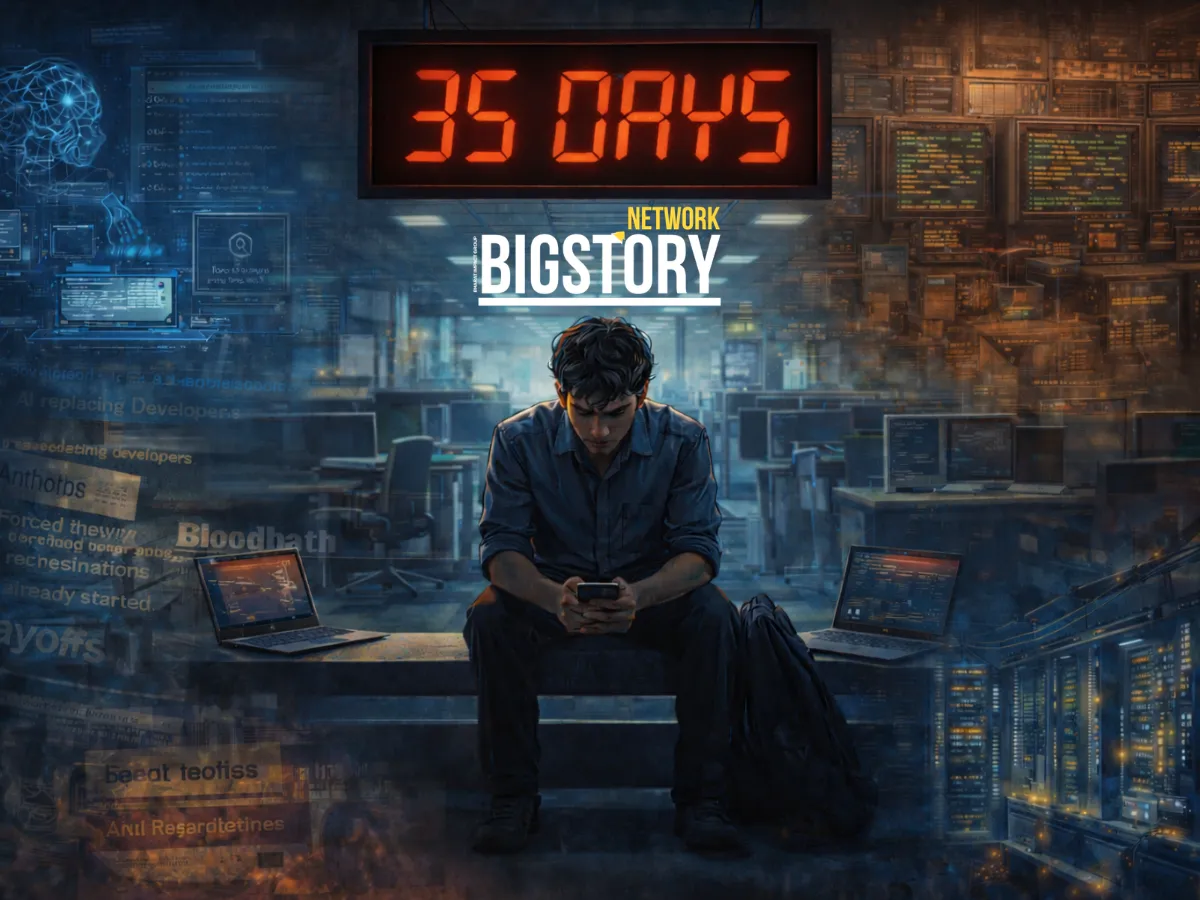
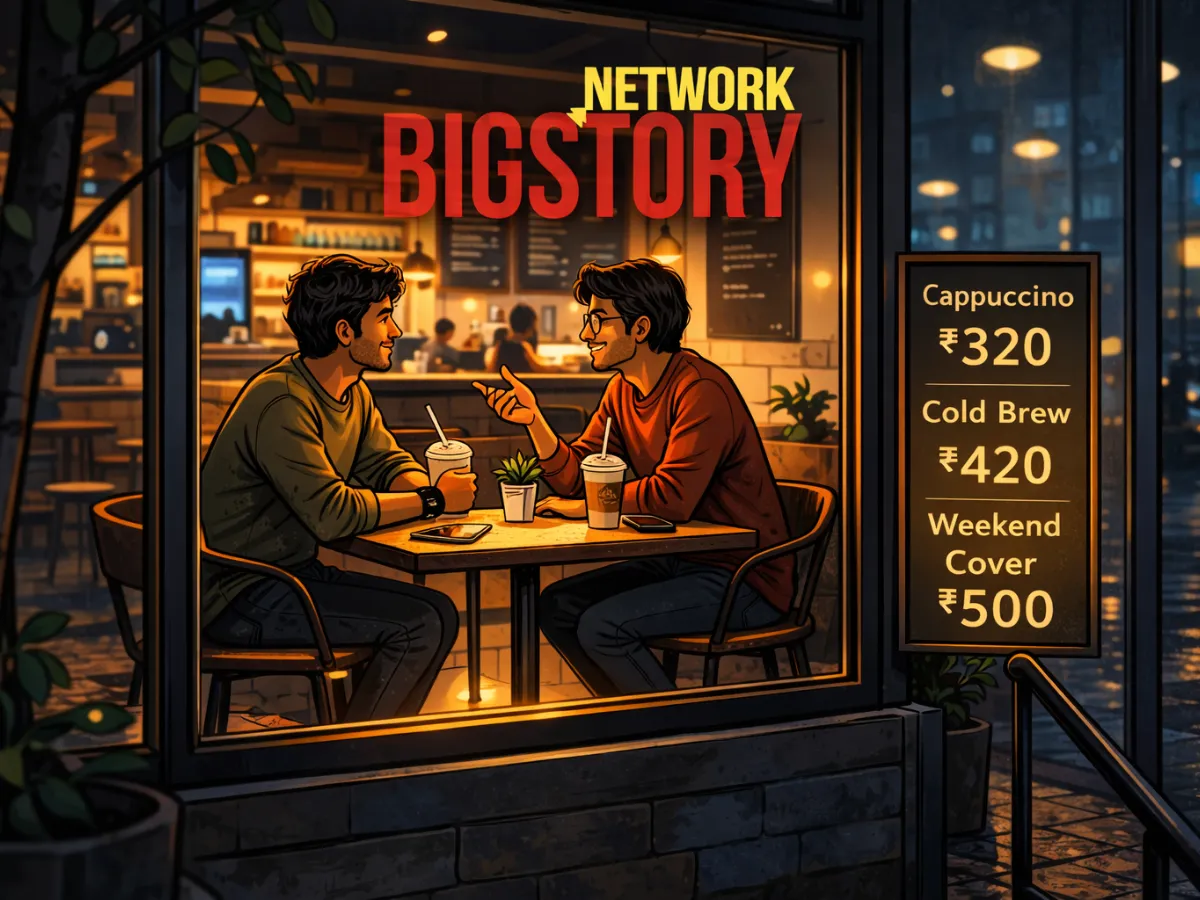
Put yourself as a graduate from a decent engineering college. You have waited eight months for your joining letter and finally relocated to Bengaluru. From walking into your first day at a major IT firm with the quiet pride of someone who had made it — to six months later, you are on the bench with your manager deadlining that you have 35 days to find a billable project, thus initiating a countdown and an internal meltdown parallelly.
And the worst part? That person is not alone. If you happen to go through Reddit threads of r/developersIndia, the posts read like dispatches from a warzone. "Forced resignations have already started. Bloodbath." "So basically mass layoffs without the company taking the blame." "Enjoy your 35-day countdown to career purgatory."
You can feel this anxiety in the smoking zones of Electronic City, Hinjewadi, and HITEC City. A low-grade, persistent dread that spikes every time Silicon Valley streams a new demo.
In February 2026, that dread crystallised into something historic. When Anthropic released Claude Code — an autonomous agent capable of writing, debugging, and deploying enterprise software — the Nifty IT index plunged 20%. Steepest drop since the 2008 financial crisis. Roughly $50 billion in market capitalisation gone in weeks.
The media narrative solidified overnight: "The Indian IT services model is mathematically dead."
Look at the numbers. Anthropic, a five-year-old startup, suddenly commanded a $380 billion valuation — eclipsing the combined market cap of TCS, Infosys, Wipro, HCLTech, and Tech Mahindra. Meanwhile, the top five Indian IT firms added a net total of exactly 17 employees over nine months. Not 17,000. Seventeen. TCS alone shed nearly 26,000 roles while tightening its bench policy to 35 days — the countdown from unallocated to unemployed.
For the 5 million people working in this sector, the math feels terrifying. If intelligence is now virtually free, what happens to the human capital that built the Indian middle class?
Although the fear is completely justified, the conclusion is dead wrong.
Here is the part that did not make it into the panic coverage. On the same day the markets were melting down, IBM's Senior Vice President Rob Thomas published a rebuttal that media houses largely ignored. His argument was simple and devastating: "Translating code is one thing. Modernising a platform is something else entirely."
The market had made a catastrophic category error. It confused an AI model's ability to read and rewrite COBOL syntax in a demo environment with the ability to actually replace a 40-year-old, heavily regulated enterprise system. These are not the same thing — they are not even close to the same thing.
Consider what COBOL actually runs. In 2026, it still processes 95% of all ATM transactions in the United States and handles 80% of global credit card transactions. Every single day, COBOL-powered mainframes move an estimated $3 trillion in commerce. The reason global banks have not simply upgraded to modern cloud architecture is not technological ignorance — it is extreme systemic risk management.
The cautionary tale every banking CTO knows by heart is TSB Bank. In 2018, TSB attempted to migrate 5.2 million customer accounts from one known database to another — no experimental AI, no frontier models, just structured data moving between two relational systems. The result was catastrophic. Millions of customers were locked out. Mortgage accounts vanished. Sensitive data was cross-exposed. The cleanup cost £330 million, the CEO resigned, and regulators fined the bank £48.65 million.
That was a simple migration. What Anthropic is proposing is orders of magnitude more complex.
A Fortune 500 bank cannot simply hand an open API access to a mainframe containing the financial histories of 50 million citizens and instruct it to autonomously rewrite the core ledger. The legal exposure alone would be existential.
The problem extends beyond legal risks to a critical loss of institutional knowledge. Much of the context for the code — such as the details of a 1991 regulatory settlement or a 2003 fraud-prevention technique — has vanished because the original engineers have long since retired. While an AI can convert the syntax of the code, it cannot possibly reconstruct this essential, missing historical context.
This is what the market missed entirely — and it is precisely the gap that Indian IT has spent four decades learning to navigate.
The BFSI sector — Banking, Financial Services, and Insurance — is a cornerstone for major IT firms, representing 31.9% of TCS's revenue and 33.6% of Wipro's, while also acting as the primary growth engine for both Infosys and HCLTech. These institutions are far from typical clients; they are the most heavily regulated, compliance-driven, and risk-averse organisations globally. These are precisely the clients that cannot simply integrate a San Francisco API into their core systems without an extensive human layer facilitating the integration.
That integration layer has a name. It is called Indian IT.
But most of you already have the obvious question: if the enterprise moat is so impenetrable, if Indian IT is so structurally irreplaceable, then why are 26,000 TCS employees out of the door? Why are freshers waiting two years for joining letters that never come? Why are engineers with five years of experience and top performance bands lying awake at 2am checking their bench countdown?
That is because the moat protects the company. It does not automatically protect the job inside it.
What is dying is not Indian IT. What is dying is a specific version of work within Indian IT — the pyramid model. For three decades, revenue growth meant hiring more bodies at the base. Junior developers doing repetitive maintenance. Mid-level managers supervising teams of people doing tasks that a well-prompted AI can now execute in minutes. Quality assurance engineers running test cycles that automated pipelines handle overnight.
Read that again. The work is gone. Not paused. Gone.
Globally the restructuring is brutal and indiscriminate. Jack Dorsey's fintech company, Block Inc., pivoted to a leaner, AI-driven business model, announcing plans to cut nearly 50% of its workforce — over 4,000 employees. Open-source AI plugins are now freely replicating the core products of many SaaS companies, especially those focused on automating niche workflows. The S&P Software and Services index lost 25% of its value between January and late February 2026.
The Citrini Research report that went viral during the crash identified something particularly chilling for India — what it called Ghost GDP. AI drives massive productivity gains and inflates corporate profits, but because human labour is displaced, the generated wealth does not circulate back as wages or consumer spending. Companies lay off workers, use the savings to buy more AI, which allows them to lay off more workers. There is no natural brake on the loop.
For Indian IT specifically, the numbers tell the story with brutal clarity. Between January 2023 and July 2025, the percentage of employees aged 21 to 25 at large tech companies was cut in half. Job postings requiring three or fewer years of experience dropped by 15 percentage points. The industry is not just restructuring its present workforce — it is closing the door on the next generation entirely.
But here is what the panic coverage keeps missing. The companies are not shrinking. They are rotating. TCS shed 26,000 roles while simultaneously doubling its fresh graduate intake and training 275,000 employees in AI capabilities. Infosys has deployed over 500 AI agents internally and is retraining its workforce to orchestrate them rather than compete with them. The job of writing basic code is dying. The job of governing, integrating, and deploying AI at enterprise scale is exploding.
The question is not whether Indian IT survives. The question is whether we people inside it are making the transition fast enough.
See, at the core of this business we are Indians and we will find some way or the other to make things work — and some of them already have.
While the markets were pricing Indian IT as a dying industry, something quietly extraordinary was happening in the closed-door sessions of the India AI Impact Summit in New Delhi. The same frontier AI labs whose products triggered the panic were signing partnership agreements with the exact companies the market had written off.
Let that sink in for a moment.
On February 17, 2026, Anthropic signed a landmark strategic partnership with Infosys. The deal embedded Claude directly into Infosys Topaz, the company's AI platform, to build agentic AI solutions specifically for the industries that cannot touch a raw AI model — banking, telecom, insurance, and manufacturing.
But the more important signal was what Anthropic's own CEO Dario Amodei said to justify the deal. His words were precise and devastating to the doom narrative: "There's a big gap between an AI model that works in a demo and one that works in a regulated industry — and if you want to close that gap, you need domain expertise."
Read that carefully. The CEO of the world's most valuable AI startup just told you that his company needs Infosys to sell to banks. That is not a eulogy for Indian IT. That is a job description.
On February 19, OpenAI launched its India initiative with an announcement that landed even harder. OpenAI became the first customer of TCS's new data centre business, HyperVault, committing to 100 megawatts of AI compute capacity with a contractual roadmap to scale to 1 gigawatt. This is a direct node in OpenAI's global Stargate project — the $500 billion initiative to build the next generation of AI supercomputers. Sam Altman did not go to Amazon. He did not go to Google. He went to TCS.
Simultaneously, TCS is rolling out ChatGPT Enterprise to hundreds of thousands of its own employees and has become the first organisation outside the United States to offer official OpenAI certifications — creating a self-reinforcing ecosystem where its workforce is trained on the exact tools that define the infrastructure they now manage.
The broader deal sheet from the summit tells the same story at scale:
Microsoft committed $50 billion to the Global South. Google launched $60 million in targeted AI funds in India. AMD expanded its partnership with TCS to deploy 200 megawatts of AI infrastructure. Blackstone led a $600 million investment into Indian AI cloud startup Neysa. The total investment commitments made at the summit crossed $250 billion.
This is not a sector in terminal decline. This is a sector being rewired in real time — from selling human hours to owning the infrastructure layer that every frontier AI company needs to reach the world's most regulated, most complex, and most lucrative enterprise clients.
Silicon Valley owns the intelligence. Indian IT is building the road it travels on.
Here is the thesis that the panic coverage buried completely.
The global AI market is currently valued at $390 billion. Within that number, the single largest revenue segment is not the models, not the hardware, not the data centres — it is services: the implementation, integration, and orchestration layer that commands 36.3% of total market revenue, growing faster than every other segment at a projected 37% annually through 2033.
Silicon Valley builds intelligence — but someone has to deploy it. And here is the twist: deployment is not a simple problem. McKinsey's 2025 State of AI report found that while 88% of organisations now use AI in at least one business function, only 6% are successfully scaling it to generate meaningful returns. The other 94% are stuck in what analysts call pilot purgatory — impressive demos with negligible real-world impact. The bottleneck is not the technology. It is the implementation.
Fortune 500 companies cannot operationalise the AI tools they already own. They lack the engineers to build RAG pipelines that ground AI outputs in proprietary data. They lack the MLOps infrastructure to prevent their systems degrading silently over time. And they lack the compliance architecture to deploy across jurisdictions with conflicting data residency laws. They have the intelligence. They do not have the road.
That road is what Indian IT is building.
TCS is generating $1.8 billion annually in AI services revenue — growing at 17.3% quarter-on-quarter — and has trained 217,000 associates in advanced AI capabilities. Infosys has engaged over 90% of its top 200 clients on AI initiatives through its Topaz platform. HCLTech became the first major Indian IT firm to break out standalone AI revenue, reporting over $100 million in a single quarter. These are not aspirational targets. These are current run rates.
The business model has fundamentally shifted. Indian IT is no longer billing for human hours. It is billing for outcomes — the successful modernisation of a legacy banking system, the compliant deployment of an AI agent across 14 jurisdictions, the RAG pipeline that makes a telecom company's 40 years of customer data actually usable. When a firm like TCS uses AI to compress a three-year modernisation project into eight months, it does not pass all of that efficiency to the client. It captures a portion as margin. The toll booth collects whether traffic moves fast or slow.
This is the model that Dario Amodei validated when he partnered with Infosys. This is the model that Sam Altman endorsed when he chose TCS for Stargate. The world's two most powerful AI labs did not build their own enterprise deployment arms. They knocked on the door of Indian IT.
Let us be clear about something the industry will not tell you directly.
The toll booth exists. The deals are real. But the transition will not save everyone — and pretending otherwise is a disservice to the 5 million people whose livelihoods are inside this industry.
This structural shift was not the fault of the 2024 graduate entering a frozen job market, nor the mid-level Java developer whose years of maintenance work are now instantly handled by AI, nor the QA engineer whose entire role was automated overnight. These are real people bearing the cost of a change they neither created nor were prepared for.
The data is unsparing. Between January 2023 and July 2025, the percentage of employees aged 21 to 25 at large tech companies was cut in half. Job postings requiring three or fewer years of experience dropped by 15 percentage points. The industry is not just restructuring its present workforce — it is closing the entry door on an entire generation.
The Citrini report warns of a pipeline collapse — arguing that the short-term efficiency gain is creating a long-term structural problem. If no junior developers are hired and mentored today, the industry will face a catastrophic skills deficit in the architects and systems thinkers it needs five years from now. That issue is not being discussed with adequate urgency in any boardroom.
But you are reading this because you want to know what to do. So here is what the data actually shows.
The 6% of organisations successfully scaling AI share one defining characteristic. They did not treat AI as a technology problem. They treated it as an organisational rewiring problem — dedicating 70% of their AI budget to people and workflow redesign, not software licenses.
The engineers thriving in this transition are not the ones who learned to use AI tools. They are the ones who learned to think about entire systems — how data moves, where it gets corrupted, how compliance requirements shape architecture, how a client's 40-year-old process needs to be rebuilt from scratch rather than automated on top of. That is the skill the toll booth needs. Not prompt engineering. Not basic Python. Systems thinking, domain expertise, and the ability to sit across from a risk-averse banking CTO and translate what an AI agent can and cannot safely do in their environment.
The geography of opportunity is also shifting in ways that matter for where you are. Tier-2 cities are no longer second-choice destinations — they are strategic. Bhubaneswar, Coimbatore, and Chandigarh now house approximately 10% of India's total technology talent pool. The Odisha AI Policy 2025 is building compute infrastructure, partnering with IIT Bhubaneswar and IIIT Bhubaneswar on LLM development, and positioning the state as a hub for AI-driven governance. Cognizant has opened offices here. Wipro and TCS are scaling operations. The talent that stays closer to home and builds deep domain expertise in emerging hubs may be better positioned than the talent chasing bench assignments in Electronic City.
The honest answer to the question everyone is actually asking — will my job survive — is this. The job you have today probably will not exist in its current form in three years. But the professional you can become in three years, if you start now, is more valuable than anything the pyramid model ever produced.
The pyramid needed bodies. The toll booth needs architects.
The Indian IT industry is not dying. It is being restructured violently, unevenly, and with insufficient regard for the human cost of that transition. The companies will survive. The question of who survives with them depends entirely on whether the people inside this industry treat the next three years as a threat to endure or a transition to engineer.
You built the back office of the world once. We believe you can build its AI infrastructure next.
1. Anthropic — Claude Code Launch
2. Nifty IT Index — February 2026 Crash Coverage, Economic Times
3. IBM — Rob Thomas Rebuttal on COBOL Modernisation
5. Wikipedia — TSB Bank IT Migration Failure
6. TCS Q3 FY26 Results — Headcount and Revenue Data
9. HCLTech — Standalone AI Revenue Disclosure
10. Reddit — r/developersIndia Bench Policy Threads
11. NITES — Petition to Labour Ministry on TCS Bench Policy
12. Block Inc. — Workforce Reduction Announcement
13. Citrini Research — The 2028 Global Intelligence Crisis
14. McKinsey — State of AI 2025
15. Grand View Research — Global AI Market Services Segment 2025
16. Infosys Topaz — AI Platform
17. OpenAI — Stargate Project Announcement
18. TCS HyperVault — Data Centre Business
19. India AI Impact Summit 2026
21. Wikipedia — Retrieval-Augmented Generation (RAG)
 Exclusive Content

Sign up for the Daily newsletter to get your biggest stories, handpicked for you each day.



 Trending Now! in last 24hrs